Visual information materials have been produced on the functioning of the BRIDGEforEU Regulation
28 November 2025


As a result of a decade of negotiations, on May 6, 2025, the European Parliament adopted a new regulation on the instrument for the development and growth of border regions, called “BRIDGEforEU,” which entered into force on June 8, 2025. During this year, CESCI was commissioned by DG REGIO to prepare visual information materials on the functioning of the BRIDGEforEU regulation.
A 2023 publication by the European Parliamentary Research Service provided shocking data on the divisive effects of internal borders. Although it is customary to talk about the Single Market as an accomplished fact, the authors of the study showed that the removal of all legal and administrative barriers within the EU would increase the gross value added (GVA) of the EU economy by approximately €457 billion per year. This amount represents 3.8% of the total EU GVA in 2019. Even removing just 20% of the barriers would bring huge benefits: €123 billion in additional revenue and 1 million new jobs in the EU each year. These figures highlight that the barriers generated by different legal and administrative systems are not just a local, cross-border problem, but a serious economic brake affecting the whole of Europe, the removal of which would unlock significant growth potential.
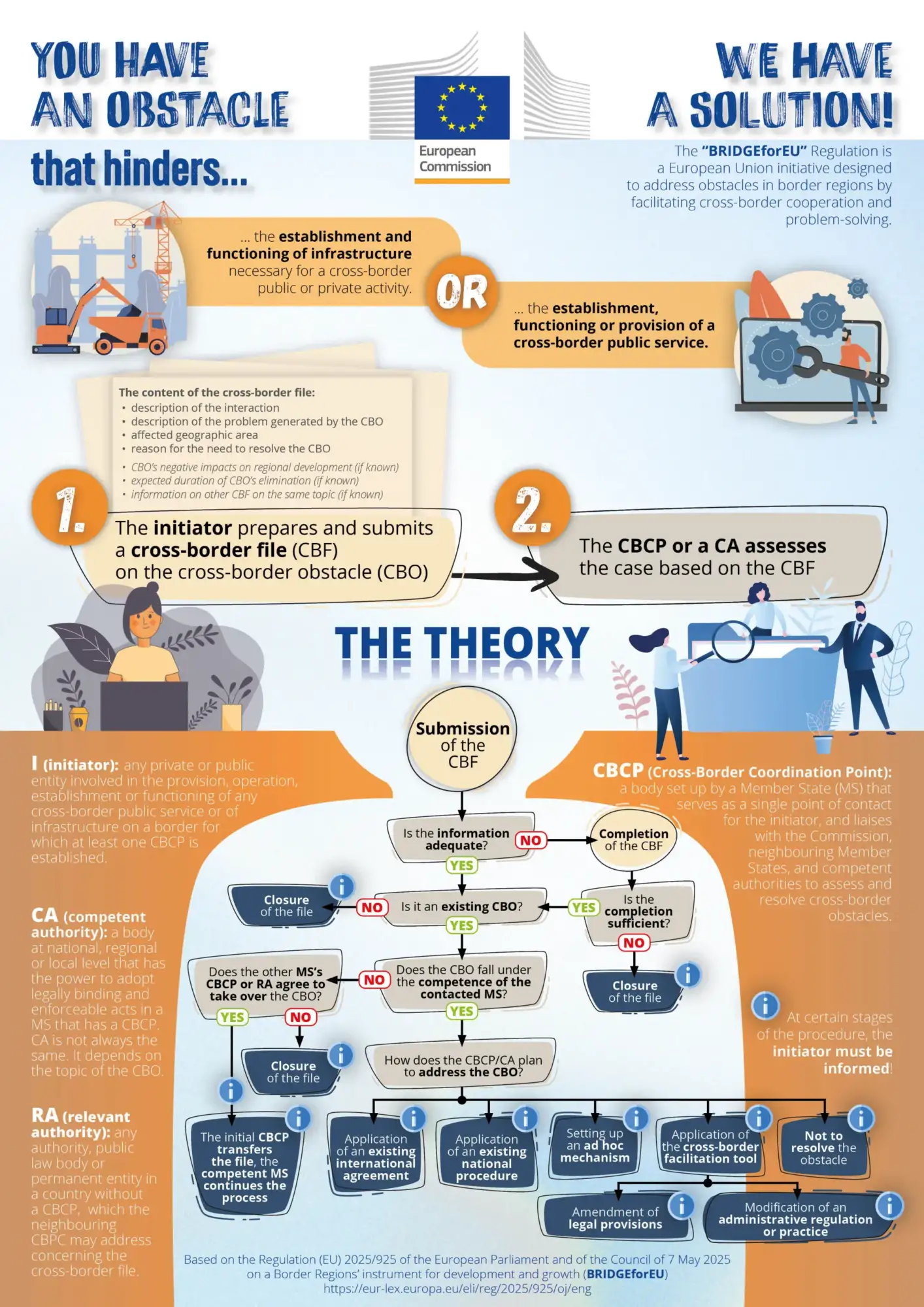
The BRIDGEforEU Regulation creates a targeted framework to systematically identify and remove the legal and administrative barriers that have been hampering the lives of people living along the EU’s internal borders and the development of the regions for decades. One of the most important and practical innovations of the new regulation is the possibility of establishing Cross-Border Coordination Points (CBCPs). These institutions will essentially function as “one-stop shops” for cross-border public service providers that encounter administrative or legal obstacles in the course of their activities. As initiators, they can report the identified cross-border obstacle to the relevant CBCP in the form of a so-called cross-border dossier. After submission, the CBCP must evaluate the dossier. The evaluation may lead to different outcomes, depending on the involvement of the competent authorities.
(1) Based on the submitted dossier, it is established that there is a genuine cross-border obstacle. In this case, the CBCP may proceed in one of the following ways:
(2) The submitted file still does not contain sufficient information after the missing information has been provided, so the CBCP closes the case.
(3) No cross-border obstacle can be identified, so the case is closed.
(4) Establish the competence of the CBCP in another Member State, contact the CBCP in that Member State or, failing that, the relevant authority in that Member State. If the other Member State agrees, the file is transferred; otherwise, the case is closed.
The use of the BRIDGEforEU framework is entirely voluntary for Member States, so they are free to decide whether to set up such coordination points at all. Hungary was the first country in the European Union to establish a coordination point, within the framework of the Ministry of Foreign Affairs and Trade, linked to the managing authority for cross-border Interreg programs. The experience of the #ACCESS project is also being used to establish the CBCP.
The various concepts, actors, and mechanisms of the regulation are presented in the following infographics, which were prepared by CESCI on behalf of the European Commission in the summer of 2025.
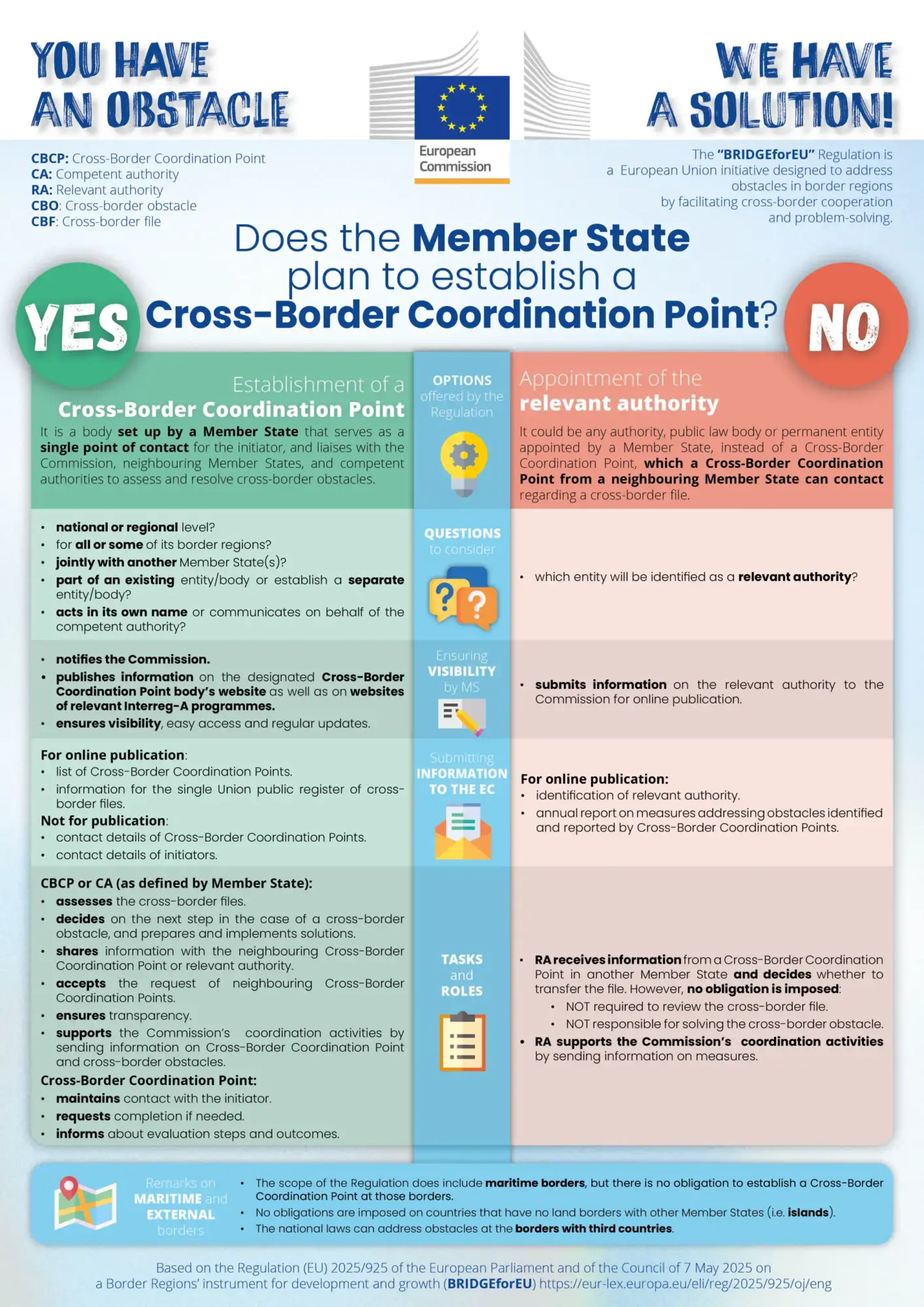
Establishment of the CBCP
The BRIDGEforEU mechanism in theory
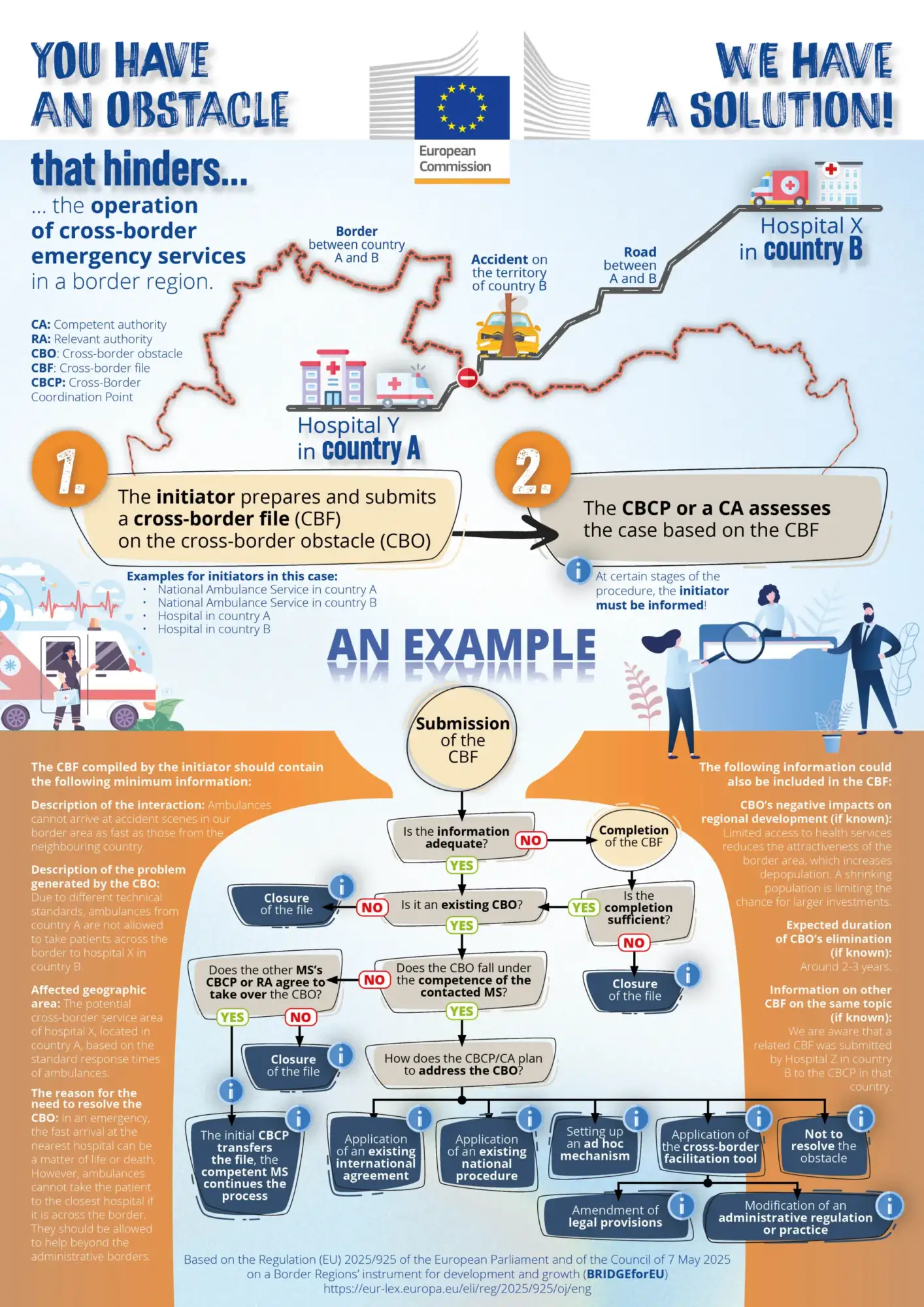
The BRIDGEforEU mechanism through a practical example
It is important to note that the regulation does not address the legal and administrative challenges faced by individuals living and commuting in border regions. The EU provides other tools to address these issues (e.g., SOLVIT, YourEurope portal, etc.).
The full text of the regulation is available in Hungarian at the following link: https://eur-lex.europa.eu/legal-content/HU/TXT/?uri=CELEX:32025R0925
The full text of the regulation is available in English at the following link: https://eur-lex.europa.eu/legal-content/EN/TXT/?uri=OJ:L_202500925

The project is financially supported by the European Union,
within the framework of the Interreg Hungary – Slovakia Programme.
For more information visit www.skhu.eu.
The project is financially supported by the European Union,
within the framework of the Interreg Hungary – Slovakia Programme.
For more information visit www.skhu.eu.

 Brief overview of the #ACCESS project developments during the second half of...