Related case descriptions

The essence of the cross-border obstacle

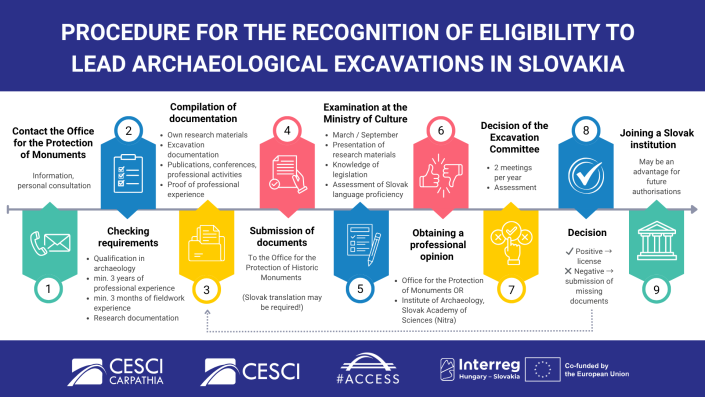
At present, the two countries have different methods for recognising archaeologists’ excavation experience, although the system of expectations is very similar. Under the current circumstances, archaeologists with excavation experience cannot find a job across the border because of administrative differences that prevent the free movement of labour.

Briefing of the situation

In Hungary, only archaeologists with a degree or a doctorate in archaeology and an employment relationship with the institution carrying out the excavation or involved in the excavation may conduct an archaeological excavation. The archeologist carrying out the excavation must also have appropriate excavation experience. Experience shall be defined as professional experience of at least 12 points gained as the head of an excavation of the given period or as a member of staff named in the excavation documentation, based on the calculation method laid down in the Government Decree on the Expertise of Monuments.

In Slovakia, natural persons cannot obtain a licence to carry out archaeological research on their own; they must be in a legal relationship with a legal person. Licensed legal entities are museums, universities, private companies and civil associations. The requirement for archaeological research to be carried out by a legal entity is justified by the need to ensure the temporary storage and preservation of archaeological finds. According to Slovak law, archaeological research may be carried out either by the Office of Historical Monuments or by a legal person established by it and employing suitably qualified persons.

These persons must be employed by a legal entity established by the Heritage Office or by the Heritage Office itself. If the legal entity is not affiliated with the Heritage Office, the Ministry of Culture is responsible for the licensing of that legal entity. The Ministry of Culture of the Slovak Republic, after passing the professional examination, issues a special certificate of professional competence for conducting research in the field of research in the field of monuments to a natural person – archaeologist – who meets the qualification requirements under Section 35a of the Monuments Act.

Hungary accepts all EU diplomas and the practice of archaeologists from abroad, so the Hungarian Excavation Committee is open to dialogue with the Slovak professional organisation and requests the mediation of CESCI in this matter. From the Slovak side, the recognition of Hungarian practice should not be a problem according to the feedback received. The Office for the Protection of Historical Monuments of the Slovak Republic and the Ministry of Culture of the Slovak Republic have already recognised the practice of archaeological research in Austria and the Czech Republic. It is important, however, that the research documentation of the archaeological excavations or parts of the excavations prepared by the applicant for the certificate must also be submitted.

History of the topic

Expert discussions are planned with the two Excavation Committees on the recognition of professional practices. The mandate of the Hungarian Excavation Committee will expire at the end of 2024 years and a new Committee will be convened in 2025. The timing of the start of the consultations is justified by the renewal of the Cultural Heritage Protection Act, due in 2025, the content of which is not yet available.

Identified good examples

The Irish example among EU cases could serve as good practice for the implementation of a common recognition system. Archaeologists working in another Member State where archaeology is a regulated profession (for the purposes of the Directive) are not required to prove their competence by attending a professional interview. The Member States where archaeologists are regulated professions within the meaning of the Directive can be found on the website maintained by the European Commission: https://ec.europa.eu/growth/toolsdatabases/regprof/. It is therefore acceptable for archaeologists to be established in another Member State (where archaeology is not a regulated profession) but to have worked as an archaeological excavation supervisor in any EU Member State for at least one year during the ten years preceding the application for an archaeological excavation permit in Ireland and to provide professional evidence of this.

Preliminary objectives

Standardised excavation permits allow for a wide sharing of knowledge and expertise between EU Member States. This will facilitate their international cooperation, enriching the results of archaeological research and contributing to a better understanding and preservation of Europe’s cultural heritage. Recognition of archaeological expertise would ensure the mobility and employment of archaeologists within the European Union, contributing to the flexibility and dynamism of the labour market. The new career model can provide better career opportunities, in particular by supporting the acquisition of experience of the younger archaeologists. A single licensing system would improve the quality and efficiency of archaeological work.

A single licensing system with uniform standards in all Member States can ensure a high professional standard of excavation, which will benefit the European archaeological community in the long term.

The essence of the cross-border obstacle

In both Hungary and Slovakia, the number of well-qualified workers is decreasing, and labour shortages have emerged in several areas and sectors. By 2030, the number of missing workers is expected to reach 300,000, a problem that will be particularly acute in the border region, so all additional forms of employment must be counted with. Both countries are aware of atypical employment opportunities, which provide workers with benefits that increase the incentive to work. Hungary has a tradition of another special atypical employment option, the cooperative employment. Under this special form of employment, workers can benefit from various benefits. For example, in the case of a co-operative for new mothers, the worker is supported by favourable tax opportunities, so that only 15% of the gross wage is deducted from personal income tax, thus supporting the workers with a preferential tax scheme. And for employers, the fact that the gross wages paid are not subject to public tax, there is less administration and only the hours actually worked need to be paid are significant advantages.

The most common employers are pensioners’, mothers’ and school cooperatives, whose members can work under pre-regulated conditions, which in practice also means simplified employment and temporary work. In Slovakia, this form of employment is not known, temporary employment agencies help workers to enter the labour market, but the range of benefits mentioned does not apply there.

Briefing of the situation

The operation of cooperatives in Hungary is regulated by Act X of 2006. The law on cooperatives requires all members of cooperatives to pay a certain amount of monetary contributions. This is usually a symbolic amount, between HUF 100 and 1000, which is returned at the end of the legal relationship. There is no further payment obligation.

The maternity cooperative discounts and facilities are available from 1 July 2021. People in receipt of childcare allowance (GYED) or childcare allowance (GYES) who have a young child at home (both mother and father) can work in a co-operative for people with young children under favourable conditions. To work through the maternity cooperative, one must be a member of the maternity cooperative. The maternity cooperative enters into a contract with the employer, which is the only way to benefit from the favourable tax treatment. Membership of the co-operative ends automatically when the entitlement to GYED or GYES ceases. The work carried out in the framework of a maternity cooperative does not constitute an employment relationship (neither a civil servant nor a public employee), so it does not affect a break in employment. If one works through a maternity cooperative, only 15% personal income tax is deducted from one’s salary. In a normal employment relationship, in addition to the 15% personal income tax, 18.5% social security contributions are deducted from the salary, for a total of 33.5%.

The pensioners’ cooperative is a company that offers retired workers the opportunity to apply for benefits and is also a recruitment agency. A significant advantage for employers is that, thanks to the benefits available to pensioner cooperatives, members’ wages are exempt from contributions. The fact that no wages are paid during holidays and sick leave, only the actual number of hours worked on the job need be taken into account, and the employer is exempt from paying rehabilitation contributions, means direct cost savings. This is a significant administrative relief, as there is no need for advertising, interviews and administrative tasks related to the recruitment, payroll and payment are not the responsibility of the client, the total service fee is entered in the accounts as one cost account. Under a transfer of responsibility, the employer is contractually linked to a cooperative with legal personality, not to an individual meaning no notice period, no severance pay. It can also be used at any time, seasonally, on a campaign basis, continuously, all year round. The pensioner must have a valid old-age pension certificate to prove his/her status. There is a choice of several options for retired work with appropriate qualifications and experience. For a cooperative, at least 90% of the members must be in receipt of a retirement pension. In addition to old-age pensioners, this category also includes women in receipt of preferential retirement. The favourable tax and contribution rules apply only to retired members.

The school cooperatives tend to specialise in qualifications, with some specialising in IT, support, development, testing, technical, business (finance, accounting, marketing, sales) and administrative student jobs, but also traditional, unskilled or casual (e.g. hostess, summer jobs, etc.), project-based and work-from-home student jobs. Their role is twofold: to provide students with work experience and a source of income, and to provide employers with human resources and supply. For students, there are clear benefits of membership of a cooperative: work experience, work that can be done as an apprenticeship, a salary commensurate with their skills, flexible working hours and good working conditions.
On the Hungarian side, the Ministry of Economic Development’s Department for Labour Market, Labour Protection and Employment Supervision is open to cooperation and joint work.

History of the topic

On the Slovak side, the legislator is being identified.

Identified good examples

Selye János University, Szent István University, Alexander Dubcek University and Óbuda University conducted a survey on typical and atypical employment patterns among unemployed people, higher education students and companies. The research was geographically focused on the Slovak-Hungarian border region of Komárom – Esztergom (Hungary) and Révkomárom (Komárno) – Párkány (Štúrovo) (Slovakia). The survey research was a follow-up to a previous study focusing on how atypical forms of employment can reduce and influence unemployment.

https://acta.uni-obuda.hu/Poor_Vinogradov_Gabrielne-Tozser_Antalik_Horbulak_Juhasz_Kovacs_Nemethy_Machova_78.pdf

https://www.researchgate.net/publication/322936076_Atypical_Forms_of_Employment_on_Hungarian-Slovakian_Border_Areas_in_Light_of_Empirical_Researches

Preliminary objectives

Providing a similar opportunity for cooperative employment in Slovakia would be a major step forward in the labour market. At present, specific workers can work on a temporary basis, but they are not eligible for the benefits. It would also be a great opportunity for employing companies, which could use the new possibilities to change employment conditions and support the effective recruitment of labour.

In a cross-border context, the new forms of work and work organisation, alongside new mobility and residence patterns, call into question the basic rules of lex loci laboris (country of work) and lex loci domicilii (country of residence), especially when it comes to individual cases. It is therefore worthwhile to approximate atypical employment practices by common agreement. https://www.researchgate.net/publication/384831362_Atypical_work_and_residence_in_cross-border_situations_The_coordination_of_unemployment_benefits

Aim: to involve legislators in expert discussions to exchange experience and open up new labour market opportunities.

Related news

Cross-border recognition of the professional experience of lead archaeologists

Cross-border recognition of the professional experience of lead archaeologists

Within the framework of the #ACCESS project, CESCI is working to identify legal and administrative obstacles that complicate the everyday ...

Related best practices

FORMA NAEN

FORMA NAEN

The FORMA NAEN project was implemented between 2019 and 2022 as part of a cross-border program between France and Spain ...