Behind the scenes: report on the latest #ACCESS project partner meeting
18 February 2026

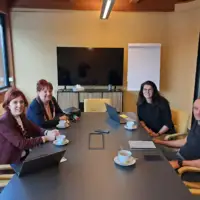
At the beginning of the year, CESCI Carpathia and CESCI Budapest continued the implementation of the #ACCESS project with renewed energy. The latest developments were discussed by the parties involved at an online partner meeting on February 3, 2026. The meeting provided an excellent opportunity for participants to review submitted and planned project proposals and to discuss the analyses being carried out within the framework of #ACCESS.
We are working on several project proposals: we have assisted in the preparation of two health-related proposals and one proposal dealing with the innovative marketing of local products, based on the results of legal and policy research carried out earlier. With regard to cooperation between healthcare institutions, the partners emphasised that when testing patient pathways, language barriers and related administrative issues (e.g. prescriptions) often only become truly apparent when the patient actually receives care on the other side of the border, which is why the sequence and timing of solutions is a key issue. The idea of a local LLM model (to reduce language barriers) was also raised, as was the need for a common glossary. On the topic of local products, we supported local actors in preparing an innovative sales channel that would allow them to test the cross-border sale of local, artisanal products. We see the pilot as a first step towards a broader, systemic solution (more flexible small producer regulations on both sides of the border).
In terms of in-depth analysis, the good news is that the Slovak legal analysis of water tour guide training has been completed and will soon be supplemented with a Hungarian analysis and a comparative analysis of the two sides. We are continuing our work on this issue and are looking for a suitable call for proposals – we are also preparing a short concept for internal use, which we can later share with potential partners. Further in-depth analyses are being prepared in parallel on the obstacles related to transport, tourism governance (Novohrad-Nógrád Geopark), and local products.
The topic of local products was particularly instructive: we identified a number of “tangible” obstacles and gathered several possible partial solutions (food hygiene, quantity restrictions, taxation, invoicing, official guidelines). With the help of our external experts, we are working on a roadmap to facilitate coordinated interventions on both sides. On the Hungarian side, the invoicing solution offered by szamlazz.hu was inspiring for our Slovak partners, giving new impetus to our joint work.
On the subject of culture, we stated frankly that legal obstacles are not currently the main issue, but rather financing and priority issues – so we need to rethink how and in what framework it is worth continuing this issue. One of the main messages of the meeting was that we need to find a way to make our work visible, as real progress in #ACCESS often comes from these quiet, meticulous professional consultations.

The project is financially supported by the European Union,
within the framework of the Interreg Hungary – Slovakia Programme.
For more information visit www.skhu.eu.
The project is financially supported by the European Union,
within the framework of the Interreg Hungary – Slovakia Programme.
For more information visit www.skhu.eu.
 Regional cooperation against invasive alien species – expert consultation...